|
• Why So Many
Switches? • Frequently
Asked Questions •
|
|
|
|
Why So Many Switches?
|
|

- With 24 different series in our rotary catalog, making
a decision on which switch will fill your needs can be confusing. Here is a simple
explanation that may help you decide.
|
|
Series
|
Characteristics |
|
C1
|
Smallest rotary switch we produce |
|
C2, C3
|
Designed for printed circuit boards |
|
C4
|
Low cost, yet designed for lots of options |
|
C5, C6
|
Most economical switch we produce |
|
C7
|
Available up to 24 positions |
|
D1
|
Smallest switch designed for MIL-SPEC ruggedness |
|
D2
|
Developed for solder termination or PC Board applications |
|
D3
|
Catalog version offers silver alloy contacts |
|
D4
|
Readily available through distribution |
|
D5
|
Most economical open-frame switch |
|
D6
|
Superior index provides smooth, reliable feel |
|
D7
|
Higher contact rating @ 2.25 amps |
|
D8
|
Provides 18 positions |
|
D9
|
Provides 24 positions with a frame less than 3 inches |
|
E1
|
Strong positive index |
|
E2
|
Linear action, up to 5 positions |
|
E3
|
Catalog version spring return action |
|
E4
|
Highest rating we offer @ 11 amps switching |
|
E5
|
Designed for printed circuit boards and 24 positions |
|
M4
|
High reliability, designed with MIL-SPECs in mind |
|
M5
|
Highest quality rotary switch we produce |
|
M6
|
Available up to 32 positions |
|
M7
|
Available up to 48 positions in a frame under 3 inches |
|
|
|
Frequently Asked Questions
|
|
Q1. What is a Pole?
A1. A pole is an isolated circuit (or input).
Q2. What is a Section?
A2. A section (or deck or wafer) is what the contacts are mounted on.
Q3. What is the difference in Shorting and Non-shorting?
A3. A shorting contact is also known as "make before break" and describes
the action of the contact as you select your switch positions. The switch will momentarily
"short" postion 1 and 2 together when you rotate from position 1 over to
position 2. A non-shorting contact is also known as "break before make".
The connection is momentarily broken when you rotate from position 1 over to position
2.
Q4. What is an Index Angle?
A4. An index angle is the number of degrees between each position. For example,
our D4 series is 30 degrees between all 12 positions (for a total of 360 degrees).
Q5. Can you make Binary Coded switches?
A5. Yes, including some gray code switches as well.
Q6. Do you provide Knobs or Dial Plates?
A6. Yes, we offer a variety of knobs and dial plates which can customize the
look of your panel. However, you must purchase them separately from your switch.
Q7. Are your switches Waterproof?
A7. We can waterproof some of our enclosed rotary and miniature switches. Our C4 series rotary and WT/WR series miniatures with actuator seals now meet the IP67 standards.
Q8. Can you change the "Feel" or Torque of the switch?
A8. Yes, we can adjust the spring in some switches to create a lighter or heavier
feel.
Q9. When should you use Gold Plating?
A9. Gold plated contacts should be used when your product needs a longer shelf life.
Also, if the switch will not be actuated for a long period of time after installation,
we recommend the use of gold plating.
Q10. What is the difference in Open Frame and Closed Frame?
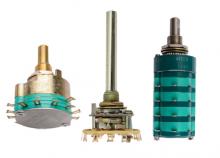
A10. The open frame switch is our wafer type switch. This construction is designed
with spacers between sections, which makes the electrical components visible. The
closed frame switch is our module type switch. This switch is completely closed with
no spacing between the sections and the electrical components are not visible.
Q11. What is the difference between Current Capacity and Current And Voltage Rating?
A11. Current carrying capacity, measured in amps, is the maximum load that this
switch will carry with the contacts in a closed position. Current and voltage rating
is the tested amperage and voltage capacity when you switch the contacts between
positions under load. When you switch between positions, an electrical arc occurs.
Over a period of time, this arc causes contact wear. A switch with the contacts closed
has no arc, and the carrying capacity is higher.
We hope this answers your questions and gives you a
better basic understanding of the Electroswitch rotary product line.
E-mail us if you have questions not answered
here or need more assistance.
|